
Elmwood Park Address History Sources
No single roll names every person who occupied an Elmwood Park property. The best source depends on the period and whether the question concerns ownership, occupancy, or the building itself. Start with a current PIN, the Property Index Number assigned to a Cook County tax parcel. Then match that PIN and its legal description to deeds, maps, directories, and household records.
| Source | Years It Covers | Where Held | What It Shows |
|---|---|---|---|
| Clerk recording index | Current online coverage; historic start not stated | Cook County Clerk | Deeds, parties, dates, PINs, and legal descriptions |
| Suburban directories | Elmwood Park/Mont Clare, 1927-1928 | Newberry Library | Names and address-linked directory entries |
| Sanborn maps | 1929 mapped portion | University of Illinois | Buildings, numbers, uses, and block form |
| Federal census | Public schedules through 1950 | Archives and library databases | Households and relationships |
| Local history material | Varied | Elmwood Park Public Library | Yearbooks, photos, articles, artifacts, and books |
For a recent transfer, use the Assessor and Clerk first. For an early twentieth-century household, pair the Newberry run, the Sanborn volume, and a census year. Village permits and code files can add later building detail, but Elmwood Park handles those records through a focused FOIA request rather than a public house-history index.
Elmwood Park Previous-Resident PIN
The Cook County Assessor address search is the cleanest bridge from a modern Elmwood Park address to a stable parcel identifier. Record the PIN, situs address, owner name, tax mailing address, class, and legal description. Situs means the physical location of the parcel. It is not the same as the address used to mail a tax bill.
A matching mailing and situs address can suggest owner occupancy, but it does not prove who lives there. Apartment residents, relatives, and other occupants may never appear on the property card. The PIN and legal description matter because street wording can change while the lot remains the same. Corner lots and rear parcels also make a street number alone unreliable.
Note: Save the search date with each parcel card because ownership, mailing addresses, and assessment details can change after a transfer.
Elmwood Park Previous-Resident Deeds
The Cook County Clerk advanced recording search supports the backward trail with grantor, grantee, document type and date, document number, trust, and legal-description controls. The former Recorder of Deeds ended as a separate office on December 7, 2020, so current research appears under Clerk Recordings even when an older citation says “Recorder.”
The live portal displayed an indexed-through date of August 6, 2026 during research, but its official search screen did not state a historical online start year. Do not invent one. If the needed instrument is absent, ask Clerk Recordings about office access, then check FamilySearch deed film, Cook County Archives remote reference, or Illinois State Archives series notes.
Open the advanced deed-search source before reviewing the captured interface.
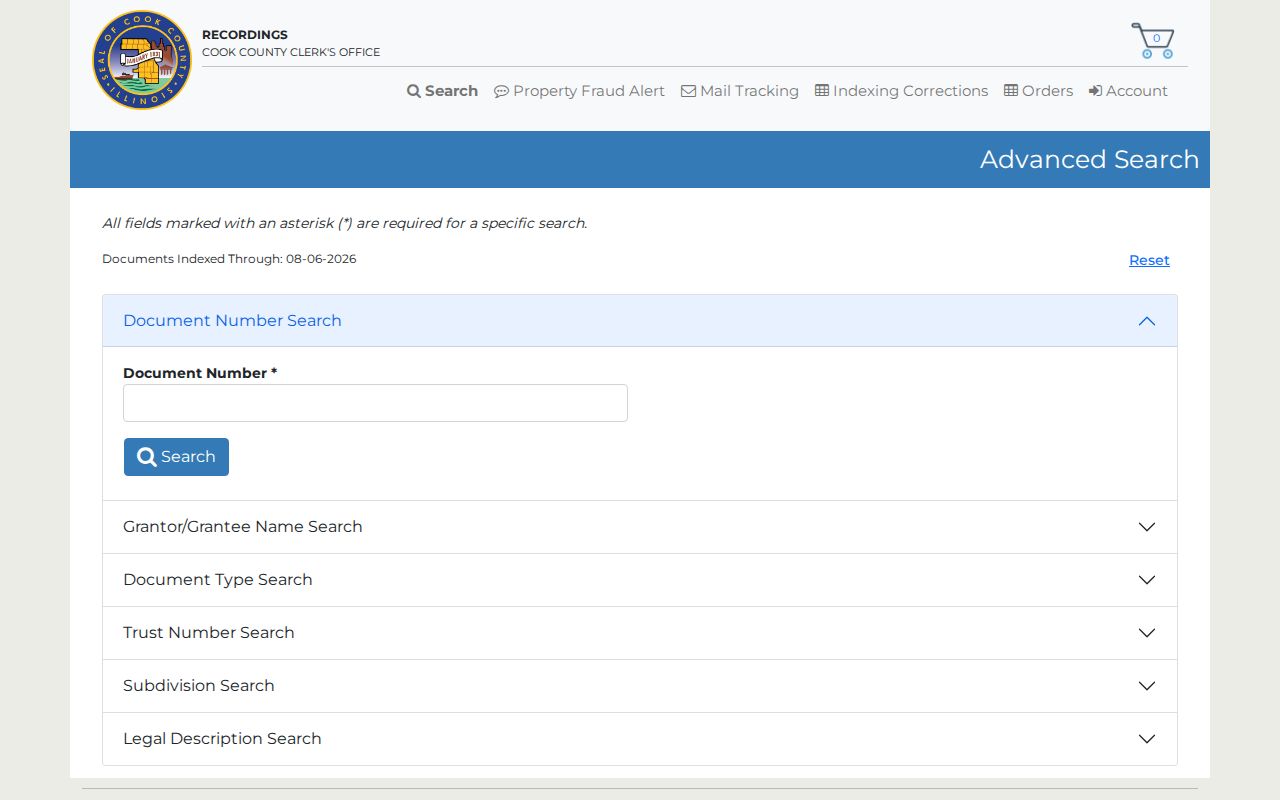
The screenshot shows why a name-only query is just one route. Subdivision, block, lot, section, township, and range can recover a deed when a past resident’s name or street label fails.
Trace Elmwood Park Past Residents
A chain of title is the linked sequence of recorded transfers for one parcel. It tracks owners, not every occupant. Begin with the current Assessor name and confirm each transfer in the recording index instead of trusting a summary from a nonofficial source.
- Copy the current PIN, owner, and exact legal description from the Assessor card.
- Search the PIN and current owner as grantee, the receiving party, and limit the document type to deeds when useful.
- Read the matching index row and identify the grantor, the party transferring the interest.
- Search that grantor as a prior grantee. Repeat while checking dates, lot data, trusts, estates, and corrected instruments.
- When online results stop, take the last verified instrument to the Clerk, film catalog, or archive rather than guessing across the gap.
- Grantor and grantee
- The grantor transfers an interest; the grantee receives it.
- Chain of title
- The documented sequence of transfers tied to the same parcel.
- Legal description
- The lot, block, subdivision, or survey wording that identifies land more precisely than a postal address.
Historic Elmwood Park Resident Addresses
Older searches need controlled spelling changes. Try West Grand and W Grand, North 72nd and N 72nd, plus standard suffix forms. Do not silently replace the official text in a result. Save each query and note which form matched.
Newberry identifies the 1927-1928 suburban run under Elmwood Park and Mont Clare or combined suburban headings. A missed modern municipality search therefore does not prove the person or address is absent. Search the legal description, adjoining parcel, plat, old suburb label, and tax map before concluding that the chain ends.
The available research found no official Elmwood Park-specific street renumbering year. Chicago’s 1909 standardization cannot be applied automatically to the Village. The Chicago Ancestors historical street guide is useful for interpreting nearby names, but it is context, not proof of an Elmwood Park change.
The captured guide shows how historic street references were organized. Pair such context with the parcel’s own legal description before connecting it to previous residents.
Previous Residents Near 1929 Buildings
The University of Illinois 1929 Sanborn volume is titled for Chicago but includes part of Elmwood Park. Its mapped local area covers a bounded portion near North 75th and North Austin, and Belmont and West North. At a scale of 50 feet to one inch, its leaves can show footprints, house or block numbers, construction clues, and occupancy labels.
A Sanborn map is not a resident roll. Use it to test whether a structure or address pattern existed, then seek a person in a directory or census. This distinction prevents a building label from being misread as a household name. Downloadable leaves also let a researcher compare the block to a modern parcel map without claiming that every present lot had the same boundary.
Elmwood Park Previous-Resident Fallbacks
An empty online result is a signal to change access channels, not proof that no deed or household record exists. For recorded instruments, take the last verified PIN, document number, party name, and legal description to Cook County Clerk Recordings. Some plats, easements, condominium declarations, and older material may require help from the downtown office or recording staff. The former Recorder name may still appear in catalogs and citations, while the Clerk is now the custodian.
Cook County Archives was closed to public visits at the research date, so remote reference was the documented route. The Illinois State Archives local-government search and the IRAD depository at Northeastern Illinois University can identify Cook County assessment, naturalization, map, vital, and related series. A catalog hit identifies a record group, not a confirmed Elmwood Park resident. Send the archive a narrow request with a surname, approximate dates, parcel description, and the last source already checked.
Village building and code records follow a different path. The Elmwood Park FOIA directory provides the request channel for permits, code cases, pre-sale inspection material, and other address-keyed files that lack a public search screen. Ask for one address, one record type, and a defined date span. A permit may name an owner, applicant, contractor, or agent, so read the role label before connecting that person to previous residents.
Elmwood Park Previous-Resident Archives
The Elmwood Park Public Library Local History Room fills gaps that web indexes leave. Its appointment-based holdings include yearbooks, photographs, articles, artifacts, local books, and DVDs. The Library also points researchers to onsite Ancestry Library Edition, Tribune historical material and obituaries, Chicago Ancestors, FamilySearch, Find a Grave, and Illinois archives.
The collection grew with the Village. Local library service began in a Mills sales office during Westwood development, moved to a storefront in 1939, later occupied Conti Parkway sites, and reached the current building in 2002. Those stages make the Library itself part of Elmwood Park’s record story. Ask staff for a street, family name, school year, and approximate period, not a broad request for all previous residents.
Elmwood Park Past Household Trail
Deeds reveal ownership, while directories and census schedules can reveal occupants. Search the 1927-1928 suburban directory under both Elmwood Park and Mont Clare headings, then compare its name and address with the closest public census schedule. Federal household schedules follow a 72-year release rule, so 1950 is available and 1960 is not yet public. The collections and abbreviations are treated more fully in the Elmwood Park city directory.
Use a simple flow: directory address to household name, household name to census enumeration area, census household to later directory, then death notice or probate file. An enumeration district is the area assigned to a census taker. Boundary labels may differ from modern Elmwood Park limits, so search adjacent geography when needed.
Tribune obituaries can name relatives, former streets, schools, and funeral details. Probate and estate deeds may explain why ownership moved after a death. Cook County genealogy copies have published thresholds of births older than 75 years, deaths older than 20 years, and marriages older than 50 years, while certified records remain subject to eligibility and ID rules.
Lawful use. Research previous residents for house history, genealogy, heirs, or personal curiosity. Never use an address trail to track, harass, or harm a living person.